
When Tagging Is Required
In commercial buildings and workplaces, new fire extinguisher requirements are governed by the National Fire Protection Association under NFPA 10 and enforced in workplaces by the Occupational Safety and Health Administration.
Once a fire extinguisher is installed in:
- An office building
- A retail store
- A warehouse
- An apartment complex common area
- A healthcare or educational facility
It must be included in your inspection and maintenance program.
That means documentation begins immediately, even if the unit is brand new.
Does a Brand-New Fire Extinguisher Need an Inspection Tag?
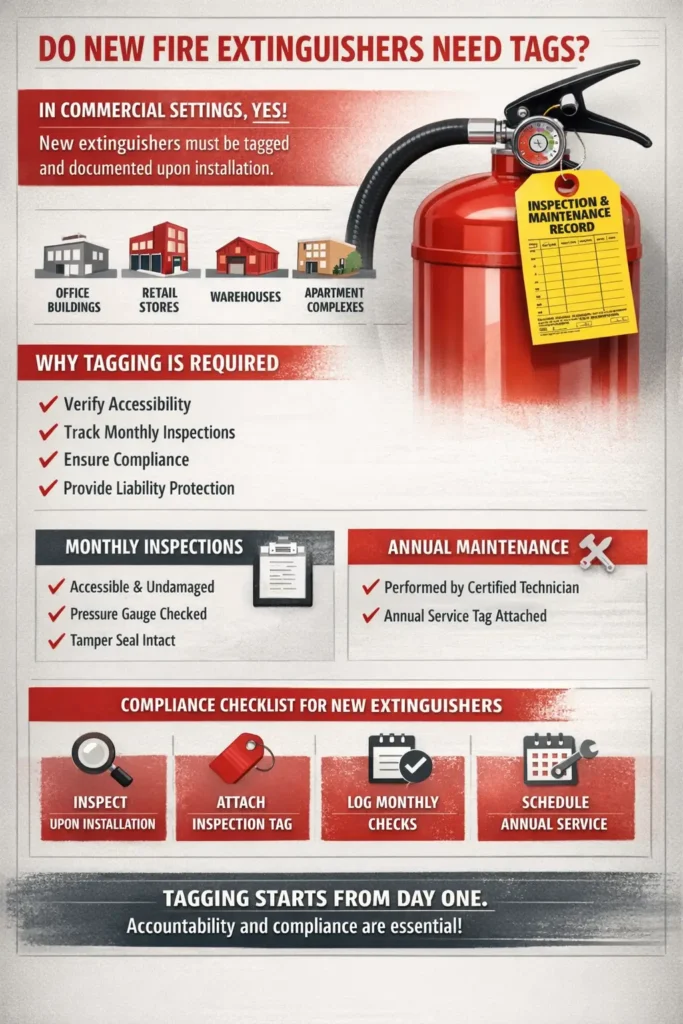
Yes, in commercial environments.
Although the extinguisher is new, it must:
- Be visually inspected upon installation
- Be added to your monthly inspection schedule
- Have documentation showing inspection activity
Many businesses attach an inspection tag at installation and begin recording monthly visual checks starting that same month.
What Type of Tag Is Required
There are typically two types of documentation associated with fire extinguishers.
Monthly Inspection Record
Fire extinguishers must be visually inspected every month.
The monthly inspection verifies:
- The extinguisher is accessible
- The pressure gauge is in the operable range
- The safety pin and tamper seal are intact
- There is no visible damage
This inspection must be recorded. Documentation may be:
- A physical tag attached to the extinguisher
- A barcode or digital tracking system
- A centralized inspection log
Even new extinguishers must be included.
Annual Maintenance Tag
A new extinguisher does not require immediate internal servicing if it is factory sealed and recently manufactured.
However, it must receive professional maintenance within one year of installation.
At that time, a certified technician will:
- Perform a full maintenance inspection
- Attach or update the annual service tag
The annual tag documents professional servicing and is separate from monthly inspection records.
What About Residential Fire Extinguishers
In private homes, tagging is usually not required by law.
Homeowners should still:
- Check the pressure gauge monthly
- Keep the extinguisher accessible
- Follow manufacturer maintenance guidelines
Tagging requirements mainly apply to regulated commercial environments.
Why Tagging Matters
The inspection tag is not just paperwork.
It provides:
- Proof of compliance during fire marshal inspections
- Evidence for insurance providers
- Documentation of regular safety checks
- Protection against liability claims
If a fire marshal inspects your property and finds extinguishers without documentation, you may receive a violation, even if the units are new.
Compliance begins at installation.
Common Mistakes Businesses Make
Businesses often assume:
- Manufacturer labels count as inspection documentation
- New extinguishers do not need to be logged
- Annual service is not required until after the first year passes
- Documentation can be added later
These assumptions can lead to compliance issues.
The moment the extinguisher is installed and available for use, it must be documented.
Compliance Checklist for New Fire Extinguishers
When installing a new fire extinguisher:
- Confirm proper placement and mounting height
- Verify the pressure gauge is in the correct range
- Attach an inspection tag or log the unit in your system
- Begin monthly visual inspections immediately
- Schedule professional annual maintenance within one year
This ensures you remain compliant from day one.
Frequently Asked Questions
Is the manufacturer’s label the same as an inspection tag?
No. The manufacturer’s label provides product details and certifications. It does not serve as proof of inspection compliance.
Can employees perform the first inspection?
Yes. A trained employee can perform and document the monthly visual inspection. Annual maintenance must be performed by a certified technician.
When does hydrostatic testing begin?
Hydrostatic testing intervals are based on the manufacturer’s date stamped on the cylinder, not the installation date.
Final Answer
Yes, a new fire extinguisher must be tagged and documented once it is installed in a commercial setting.
Even though it is unused, it must:
- Be visually inspected
- Be added to your monthly inspection schedule
- Receive professional maintenance within one year
Tagging is not about the age of the extinguisher. It is about accountability, compliance, and ensuring the equipment is ready when needed.