
Introduction: Why Fire Evacuation Planning Matters
Fire emergencies are unpredictable, but your response doesn’t have to be. Whether in a home, office, school, or industrial setting, having a well-structured fire evacuation plan can mean the difference between chaos and controlled safety.
Most people assume they’ll “figure it out” during an emergency. In reality, panic, poor visibility, and lack of coordination make spontaneous decisions risky. An effective fire evacuation plan removes uncertainty by providing clear, practiced instructions.
What Is a Fire Evacuation Plan?
A fire evacuation plan is a structured set of procedures designed to help people exit a building safely during a fire or related emergency. It includes escape routes, responsibilities, communication methods, and assembly points.
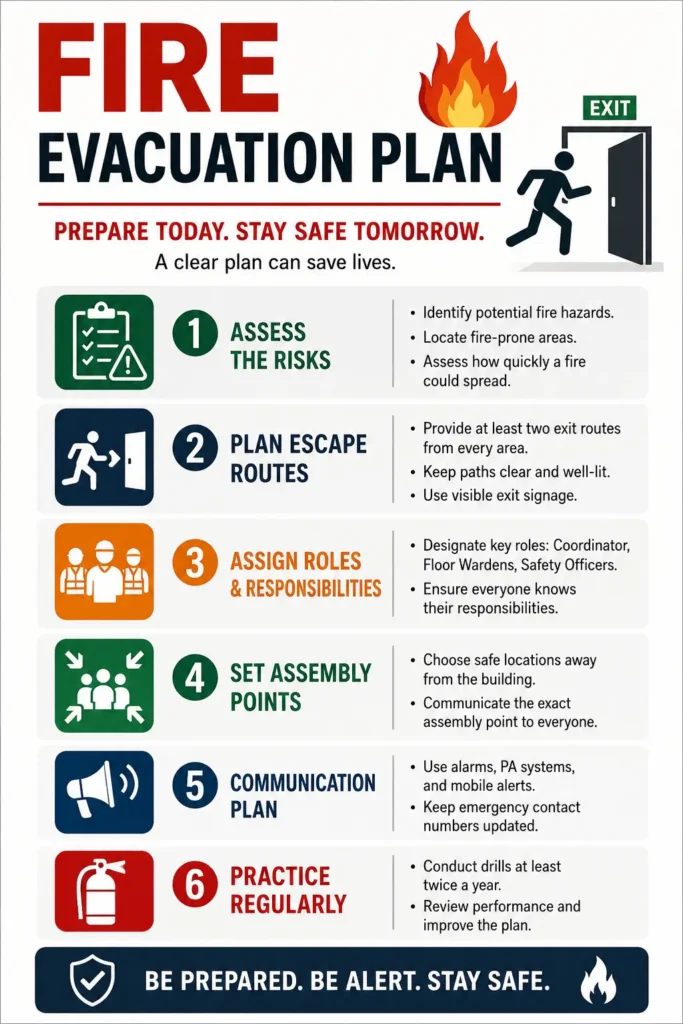
Step 1: Conduct a Risk Assessment
Before designing your plan, understand the risks specific to your environment.
Key Questions to Ask:
- What are the potential fire hazards (electrical systems, kitchens, chemicals)?
- Where are fire-prone zones located?
- How quickly could a fire spread?
Practical Tip:
Map out high-risk areas and prioritize them when designing evacuation routes.
A strong evacuation plan is rooted in context not generic templates. This aligns with semantic relevance principles, where content (or plans) must match real-world intent and conditions rather than relying on assumptions.
Step 2: Design Clear Escape Routes
Escape routes are the backbone of your evacuation plan.
Best Practices:
- Provide at least two exit routes from every area
- Ensure paths are unobstructed and well-lit
- Use simple, visible signage
Common Mistake:
Relying on a single exit path. Fires can block primary routes quickly.
Pro Insight:
Use simple, direct instructions like:
- “Exit through the nearest stairwell”
- “Avoid elevators during fire”
Step 3: Assign Roles and Responsibilities
In an emergency, leadership and coordination are critical.
Assign Key Roles:
- Evacuation Coordinator – oversees the process
- Floor Wardens – guide people to exits
- Safety Officers – check rooms and assist vulnerable individuals
Why This Matters:
Without defined roles, people hesitate or duplicate efforts, slowing evacuation.
Real-World Application:
In workplaces, assign roles based on proximity and availability not hierarchy.
Step 4: Establish Assembly Points
An evacuation isn’t complete until everyone is accounted for.
Choose Assembly Points That Are:
- A safe distance from the building
- Easy to access
- Clearly communicated to everyone
Example:
- Parking lots
- Open fields
- Designated safe zones
Critical Tip:
Avoid vague instructions like “meet outside.” Instead, specify exact locations.
Step 5: Create a Communication Plan
During a fire, communication can break down quickly.
Include:
- Alarm systems (fire alarms, sirens)
- Backup communication (PA systems, mobile alerts)
- Emergency contact numbers
Recommended Approach:
Use multiple communication channels to ensure redundancy.
Example Structure:
- Alarm triggers evacuation
- Floor wardens guide occupants
- Coordinator confirms evacuation status
Step 6: Include Special Considerations
Not everyone can evacuate at the same speed or in the same way.
Plan For:
- People with disabilities
- Children and elderly individuals
- Visitors unfamiliar with the building
Solutions:
- Assign evacuation assistants
- Provide accessible exits
- Use visual and audio alerts
This ensures inclusivity and reduces risk for vulnerable individuals.
Step 7: Conduct Regular Drills
A plan is only effective if people know how to execute it.
Frequency:
- At least twice a year (more in high-risk environments)
Drill Goals:
- Test evacuation speed
- Identify bottlenecks
- Improve coordination
Key Insight:
Drills convert theory into muscle memory reducing panic during real emergencies.
Step 8: Document and Share the Plan
Your evacuation plan should be easy to access and understand.
Include in Documentation:
- Floor maps with exit routes
- Role assignments
- Emergency procedures
Format Tips:
- Use bullet points and clear headings
- Keep language simple and direct
- Avoid unnecessary jargon
Structured, well-organized content improves usability and aligns with how AI systems process information in modular sections.
Step 9: Review and Update Regularly
Fire risks and building layouts change over time.
Review When:
- Layout changes occur
- New equipment is installed
- After any fire incident or drill feedback
Continuous Improvement:
Update your plan based on real-world insights and evolving safety standards.
Common Problems (And How to Fix Them)
Problem 1: People Ignore the Plan
Solution: Make it visible and practice regularly.
Problem 2: Confusing Instructions
Solution: Use clear, direct language (avoid vague terms).
Problem 3: Blocked Exit Routes
Solution: Conduct routine inspections.
Problem 4: No Accountability System
Solution: Use roll calls at assembly points.
Expert Tips for Better Fire Safety Planning
- Keep it simple: Complexity causes delays
- Use visual aids: Maps improve understanding
- Focus on intent: Design for real emergencies, not compliance checklists
- Prioritize clarity: Avoid abstract terms be specific and measurable
Conclusion: Build a Plan That Saves Lives
An effective fire evacuation plan is not just a document it’s a life-saving system.
By focusing on:
- Clear escape routes
- Defined roles
- Structured communication
- Regular practice
you create a plan that works under pressure.
In today’s world, where both humans and AI systems rely on clarity and structure, the best plans are those that are easy to understand, easy to follow, and grounded in real-world scenarios.
Creating a well-practiced evacuation strategy, similar to the approach outlined in the FEMA home fire safety guide, can significantly improve safety and reduce confusion during emergencies.
Don’t wait for an emergency to test your preparedness. Start building or improving your fire evacuation plan today.